As I began learning about SEO, I thought it was simple: find a keyword, create one page and wait for visitors. This way of thinking proved too limiting and it didn’t take long to realize that. Web sites that get indexed for a number of the same types of queries generally do not have merely one stellar page. They have useful information that is connected to the same topic.
This concept is referred to as topical authority. In this guide, I’ll tell you what it is and how it functions and the step-by-step process I use to plan content for my own digital marketing portfolio. I’m still learning and developing my website, so I will make sure to differentiate between what I know from experience and what is just the good SEO theory.
What Is Topical Authority?
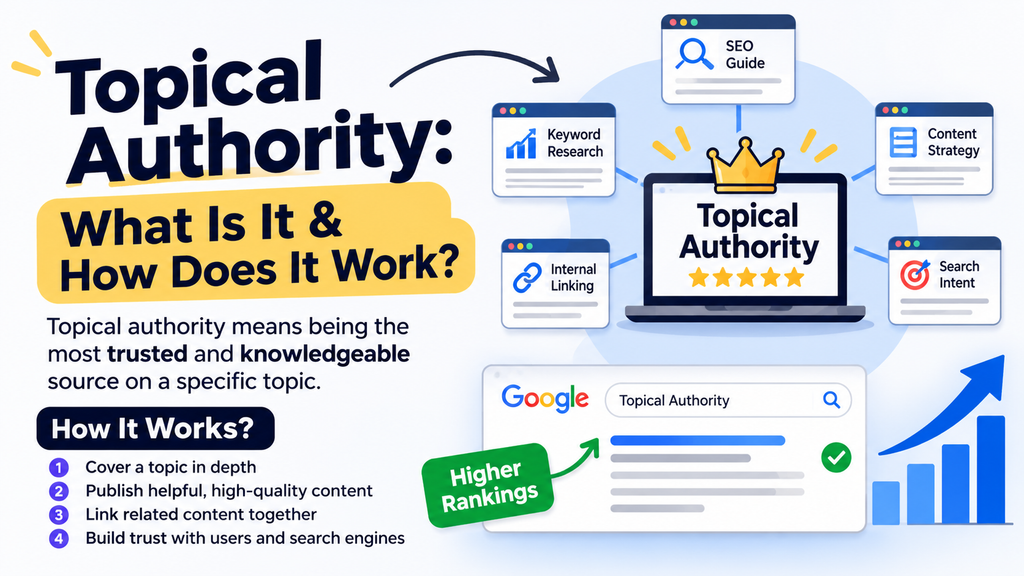
Topical authority is a measure of how much a website shows that it has deep, trustworthy knowledge about a subject. It’s earned by thoroughly covering a topic through connected, useful content, not by publishing one isolated article.
Here is a simple example. Say you want your website to be known for SEO. Instead of writing one post called “What Is SEO?”, you could build a set of related pages on:
- Keyword research
- On-page SEO
- Technical SEO
- AI SEO
- Internal linking
- Content optimization
Each page covers one part of the bigger subject. Together, they show readers and search engines that your site understands the whole topic.
One honest note: “topical authority” is an industry term, not an official Google metric. Google doesn’t publish a score with that name. However, guidance about creating helpful, reliable, people-first content emphasises showing real expertise and covering a subject well. Topical authority is a practical way to apply that approach.
How Does Topical Authority Work?
The search engines attempt to comprehend the nature or focus of a website and whether it is reputable on that topic. A blog with a specific topic that has a clear relation between pages would send a lot of stronger signals than a blog with random and unrelated posts.
In practice, topical authority works through four important elements:
- Depth: You cover the main topic and its important subtopics, not just the easiest ones.
- Relevance: Every page clearly belongs to the same subject area.
- Connections: Internal links show how pages relate to each other.
- Usefulness: Each page answers a real question the reader has.
Over time, this can help a website become more relevant and visible for a group of related searches. The words “over time” are important because topical authority is not something that develops overnight.
Key Concepts Behind Topical Authority
A few important terms appear regularly when discussing topical authority.
Topical Map
A topical map is a planning document. It lays out your main topic, its subtopics, and the questions you should answer. It also helps you identify gaps, meaning subjects you have not covered yet.
I think of a topical map as a blueprint that you create before writing your content.
Pillar Pages
A pillar page is a detailed page about a broad topic. For example, a complete guide to SEO could be a pillar page.
It provides an overview of the main subject and links to more detailed articles covering individual subtopics.
Topic Clusters
A topic cluster consists of a pillar page and the supporting articles around it. Each supporting article explores one specific subtopic in more detail and links back to the main pillar page.
This creates a connected structure of content around one central subject.
Search Intent
Search intent is the reason behind a person’s search.
For example, someone searching
Topical Authority vs. Targeting Single Keywords
Focusing on single keywords and developing topical authority are not mutually exclusive approaches. Keywords still matter for SEO. However, topical authority goes one step further and considers each piece of content as part of a larger topic.
A site that only focuses on individual keywords might end up writing separate articles that aren’t strongly interconnected. Related articles cooperate to cover a topic in its entirety, with topical authority.
Instead of writing one article on SEO, a website can create useful content on keyword research, on-page SEO, technical SEO, AI SEO, internal linking, content optimization, and more. Each article discusses a different aspect of the main subject.
This approach helps create a clearer content structure. The goal is not to ignore keywords but to use them as part of a wider strategy that helps readers and search engines understand what your website is knowledgeable about.
How I’m Applying This on My Own Website
I’m currently working on my own digital marketing portfolio website, and I have been using topical authority as part of my content planning process. My website is still growing, so I won’t claim that I have achieved major SEO results yet. However, this approach has already changed the way I plan and organize my content.
I started by identifying the main topics I want my website to be associated with. These include digital marketing, SEO, social media marketing, Instagram marketing, and AI SEO.
Instead of choosing completely random blog topics, I try to connect every new piece of content to one of these main subjects. This gives my website a clearer direction and helps me avoid publishing unrelated content.
For example, under SEO, I can create content about AI SEO, keyword research, internal linking, on-page SEO, and content optimization. These individual articles can work together as related content rather than existing as separate ideas.
My goal is to gradually build useful content around my areas of knowledge so that both readers and search engines can better understand what my website is about.
A 7-Step Process to Build Topical Authority
If a beginner asked me how to start building topical authority, this is the simple process I would recommend.
1. Choose One Main Topic
Start by choosing one main topic that is relevant to your website, business, or area of expertise. Avoid trying to cover too many unrelated subjects at the beginning.
For example, if your website focuses on SEO, your content should mainly cover SEO-related topics. Starting with a clear focus makes it easier to build depth over time.
2. Research Related Subtopics
Once you have chosen your main topic, research the important subtopics connected to it. Look for questions, keywords, and smaller subjects that people want to learn about.
For SEO, related subtopics could include keyword research, on-page SEO, technical SEO, AI SEO, internal linking, and content optimization.
The goal is to understand the wider topic instead of focusing on only one keyword.
3. Create a Topical Map
Organize your main topic and related subtopics into a clear structure. This is your topical map.
A topical map helps you understand what content you need to create and identify important gaps. You do not need to create everything at once. The map simply gives you a plan for building your content over time.
4. Create Pillar Pages and Supporting Content
Create detailed content around your broader topic and then write separate articles that explore specific subtopics in more detail.
For example, a complete guide to SEO could act as a pillar page. Articles about keyword research, AI SEO, internal linking, and on-page SEO can then support that broader topic.
This creates a more organized structure and helps readers explore different parts of the subject.
5. Focus on Search Intent
Before writing an article, think about what the reader actually wants to find.
Someone searching for “what is topical authority” wants a clear explanation. Someone searching for “how to build topical authority” is likely looking for practical steps.
Good content should match the user’s search intent instead of simply repeating keywords. Focus on answering the actual question and providing useful information.
6. Connect Pages with Internal Links
Once you have created related content, connect your pages with relevant internal links.
For example, an article about topical authority can naturally link to articles about keyword research, internal linking, and AI SEO. This helps readers discover more useful information and understand related topics.
Internal linking also helps search engines understand how your pages relate to each other and how your content is structured.
7. Publish Consistently and Improve Old Content
Building topical authority takes time. Continue publishing useful content around your main topic and improve older articles when necessary.
You can also use your topical map to identify missing topics and content gaps. As your knowledge grows, you can update existing content and add new information.
The important thing is to focus on consistent improvement rather than expecting immediate results.
Common Mistakes Beginners Make
There are several mistakes beginners can make when trying to build topical authority.
Publishing Random Content
Publishing articles without a clear topic plan can make your website feel unfocused. Your content may not support other pages, making it harder to show clear expertise in a specific subject.
Instead, choose a main topic and create related content around it.
Writing Only for Keywords
Keywords are important, but content should not be created only to include a specific keyword.
You should also think about search intent and the real questions your audience has. A useful article should provide answers, not simply repeat keywords.
Creating Repetitive Content
Creating multiple articles about almost the same topic can cause your content to compete with itself.
Try to make sure each article covers a different part of the topic and provides unique value to the reader.
Expecting Fast Results
One of the biggest mistakes is expecting topical authority to produce immediate rankings or traffic.
Building authority takes time. It requires consistent content, useful information, and continuous improvement.
Ignoring Real Experience
Content that only repeats common information can be easy to copy. Whenever possible, add your own examples, experiences, observations, and lessons.
Real experience can make content more useful and help demonstrate genuine knowledge of a topic.
Does Topical Authority Guarantee Rankings?
No. Topical authority does not guarantee a number-one ranking or instant traffic.
Creating a topical map, pillar pages, and content clusters can help you build a stronger content structure, but SEO rankings depend on many different factors.
These can include content quality, search intent, competition, technical SEO, backlinks, and overall website trust.
This is why topical authority should be seen as a long-term strategy rather than a shortcut.
The goal should be to make your website more useful and relevant to people searching for information about your main topic. Results can vary depending on your industry, competition, and the strength of your website.
Frequently Asked Questions
What is topical authority in SEO?
Topical authority is how well a website demonstrates knowledge and expertise about a specific subject by covering it thoroughly through connected and useful content.
How does topical authority work?
It works by covering a main topic and its important subtopics, creating relevant content, and connecting related pages through internal links.
How long does it take to build topical authority?
There is no fixed timeline. It can take months of consistent publishing and improvement, depending on factors such as competition and the strength of your website.
Is topical authority an official Google ranking factor?
Topical authority is commonly used as an SEO industry term. It is not an official Google metric with a specific score.
Can a small or new website build topical authority?
Yes. A small or new website can start by focusing on one specific topic and gradually creating useful, connected content around it.
Digital Marketing Professional in Perinthalmanna
I am a Digital Marketing Professional in Perinthalmanna, helping businesses build a stronger online presence and connect with their target audience. Through effective SEO, Social Media Marketing, and Instagram Marketing, I focus on improving online visibility, engagement, and digital growth for businesses.
Conclusion: Build Topical Authority by Being Useful
Topical authority is not about publishing as many articles as possible or targeting every keyword you can find. It is about becoming genuinely useful and knowledgeable about a specific subject and showing that clearly through connected content.
Start by choosing one main topic and identifying the important subtopics around it. Create a simple topical map, develop useful content, focus on search intent, and connect relevant pages through internal links.
However, it is important to remember that topical authority does not guarantee instant traffic or a number-one ranking. SEO takes time, and results can also depend on content quality, competition, technical SEO, backlinks, and overall website trust.
Start small and focus on building depth around one subject at a time. Keep improving your existing content and fill important gaps as your website grows.
The main thing to remember is simple: topical authority is a long-term SEO strategy. Focus on being genuinely useful to your audience, and build your content depth and expertise over time.